





Forensic Write Blocker

Project Overview

Forensic Write Blocker

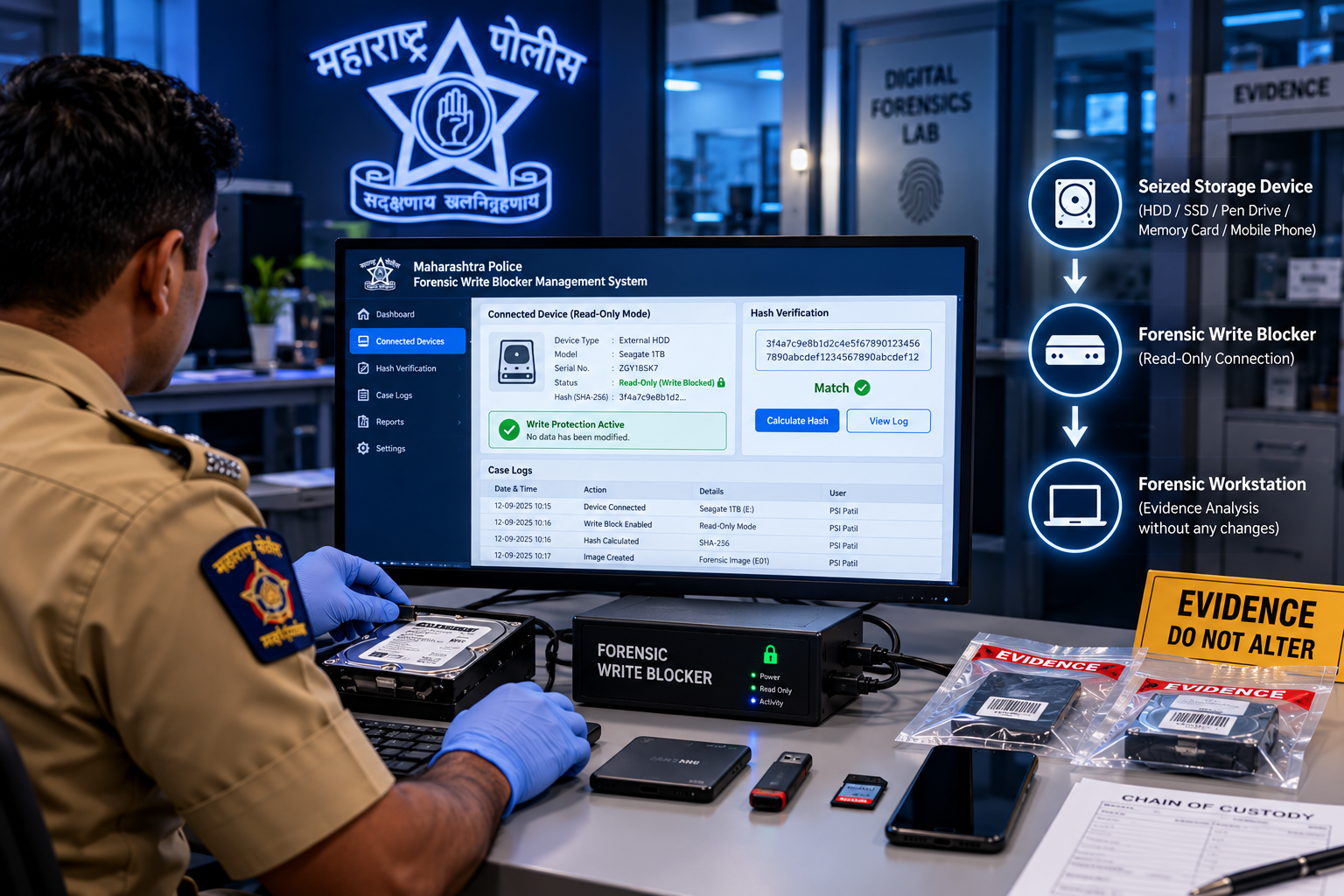
The Forensic Write Blocker is a software tool that lets investigators connect seized storage devices to a forensic workstation in read-only mode, so evidence can be examined without changing a single byte.
In digital forensics, evidence comes from hard disks, SSDs, pen drives, memory cards and phones. Simply plugging such a device into a computer can change it: the operating system may write logs, update timestamps or create hidden files. Any change can make the evidence unreliable in court.
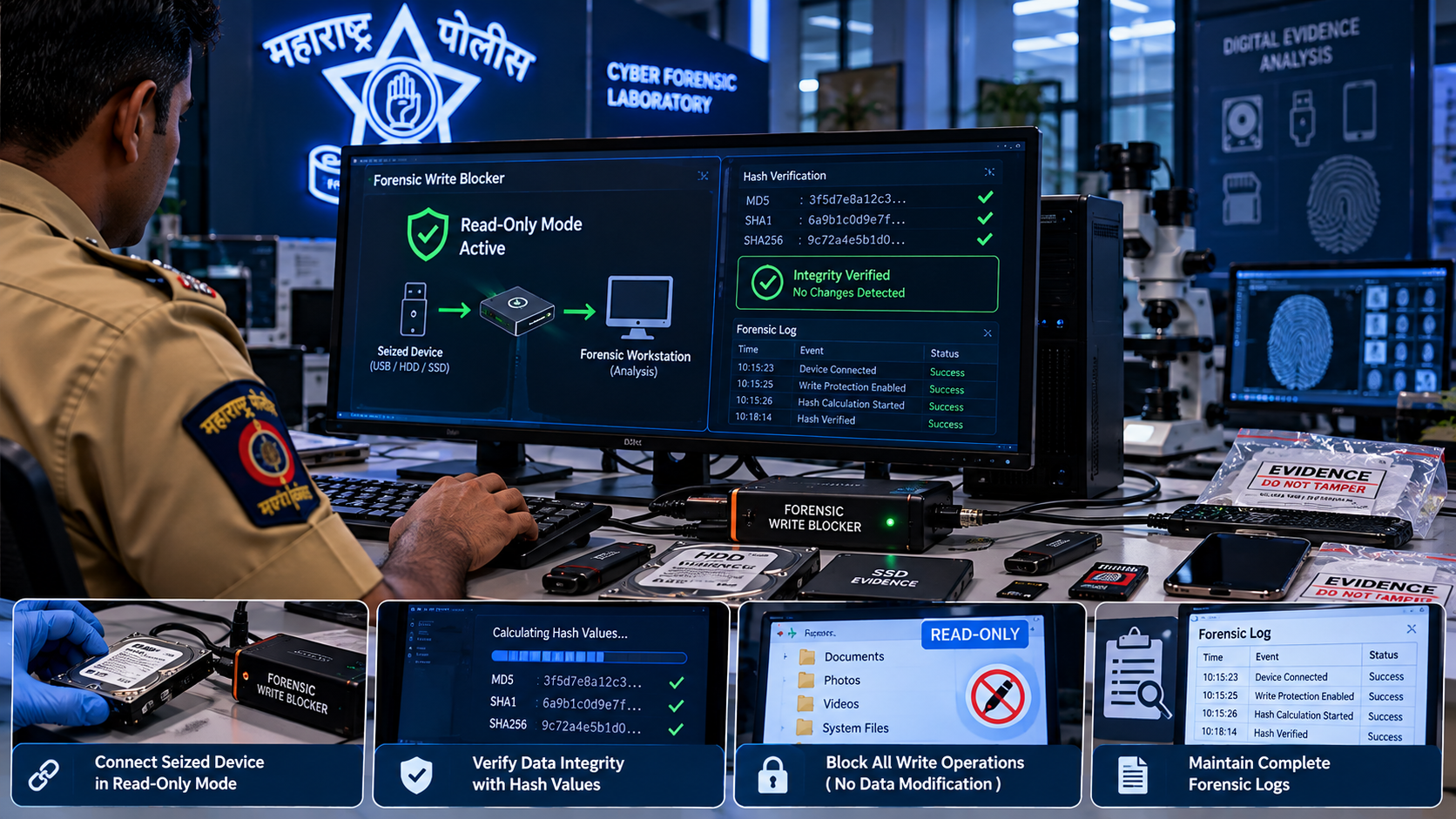
The tool blocks every write operation to connected evidence devices, verifies the protection, calculates hash values to prove the data is unchanged, and keeps a complete log for each case.
Read-Only Protection

Every write to an evidence device is blocked and verified before examination.

Proof of Integrity

MD5, SHA-1 and SHA-256 hashes compared before and after examination.

Forensic Write Blocker
Forensic Write Blocker Problem Statement
CHALLENGES BEFORE IMPLEMENTATION

Where the Previous Process Needed Improvement

  • Accidental Changes to Evidence
  • Evidence Challenged in Court
  • Costly, Limited Hardware Blockers
  • No Proof of Data Integrity
  • Manual Record-Keeping of Device Details
  • Slow Field Previews
  • Inconsistent Examination Procedure
The Solution

Solution We Provide

The tool turns any forensic workstation into a safe examination station: devices are locked to read-only, the lock is verified, and hash values prove the evidence never changed.

Read-Only Mounting

Every connected storage device is mounted read-only and all write requests are blocked.

Court-Ready Proof

Logged proof that protection was active for the whole examination session.

Software Protection on Any Workstation

Works with USB, SATA and memory-card devices, and supports quick read-only previews in the field.

Hash Verification

Hash values are calculated at the start and end and compared automatically.

Automatic Device Records

Device model, serial number, capacity and partitions are captured automatically.

Standard Workflow & Reports

A fixed, step-by-step workflow with a standard signed report for every case.
Key Features

Forensic Write Blocker Features

Automatic Storage Device Detection

Read-Only Mounting of Evidence Devices

Write-Protection Verification

MD5, SHA-1 & SHA-256 Hash Verification

Device Details Capture

Case-Wise Activity Log with Timestamps

Printable Forensic Report for Court

0
Flow Pages
0
Core Modules
0
Hash Algorithms
0
User Roles
Frequently Asked Questions

Forensic Write Blocker FAQs

  • What is a write blocker?
    A write blocker lets a computer read data from a storage device while preventing any change to it. It protects digital evidence from being altered during examination.

  • Why is it important in forensics?
    Courts need proof that digital evidence is exactly as it was when seized. A write blocker, along with hash verification, provides that proof.
  • Which devices does it support?
    Internal and external hard disks, SSDs, pen drives and memory cards connected through USB, SATA or card readers.
  • How do I know the protection is working?
    The tool runs a verification test after protection is switched on. It attempts a safe test write, confirms it was blocked, and records the result in the log.
  • What is a hash value?
    A hash value is a unique digital fingerprint of the data. If even one bit changes, the hash changes. Matching hashes before and after examination prove the evidence is unchanged.
  • Can I examine or copy files while protection is on?
    Yes. You can browse, view and copy data from the device, or create a forensic image, with no changes made to the original.
  • What happens if protection is switched off by mistake?
    Protection cannot be switched off for an evidence device during an active case session without supervisor approval, and any such action is logged.
  • Does it replace a hardware write blocker?
    It is a cost-effective alternative for many cases and for field previews. Labs can still use hardware blockers where their procedures require it.
  • What does the forensic report contain?
    Case details, examiner name, device details, protection status, verification result, hash values, the activity log and timestamps.
  • Who can use the tool?
    Only authorised forensic examiners and investigators with login credentials. Every action is recorded against the user.
Forensic Write Blocker

Have a question about the Forensic Write Blocker? Get in touch with our team to learn more.